
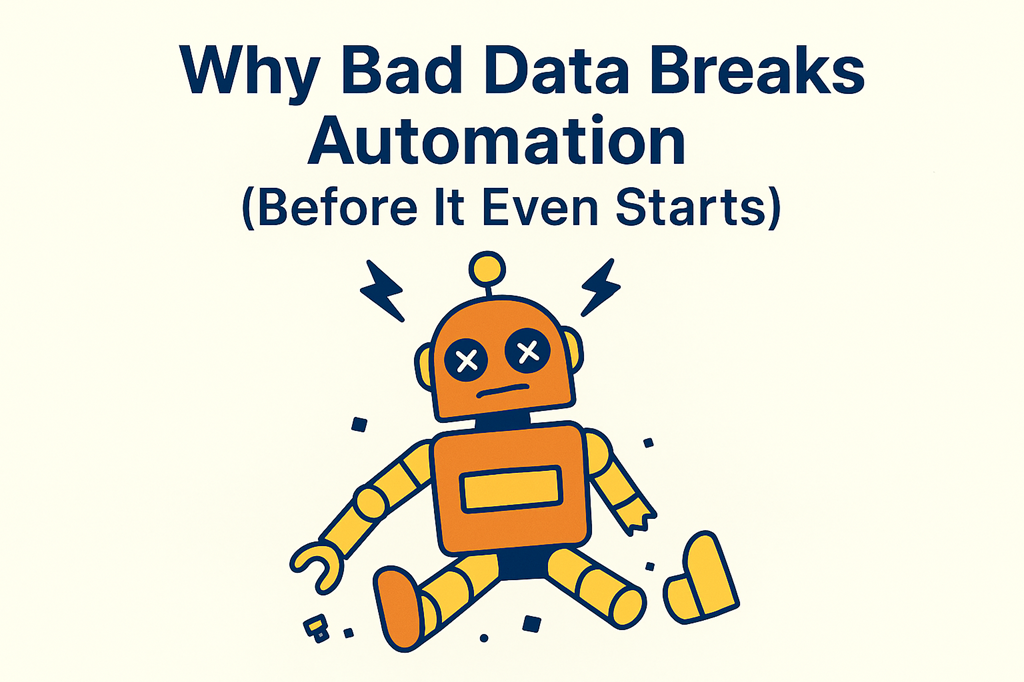
Why Bad Data Breaks Automation (Before It Even Starts)
Bad data is one of the biggest reasons automation projects fail — long before any technology goes live. In this post, we explain how inconsistent, incomplete and poorly owned data quietly breaks automation, why these issues scale as businesses grow, and what foundations you need in place to make automation work properly.
Tayo Richards
2/23/20261 min read
Automation can look impressive on the surface — faster processes, fewer manual tasks, slick dashboards.
But behind the scenes, most automation failures come down to one simple issue:
bad data.
Not the software.
Not the tools.
The data feeding them.
Automation follows data — not logic
Here’s the fundamental truth many businesses miss:
Automation is obedient, not intelligent.
It does exactly what the data tells it to do.
If the data says route this request to John, it routes it to John.
Even if John left six months ago.
Even if the email field is blank.
Even if the amount is in the wrong currency.
Automation doesn’t question data.
It follows it.
The most common data problems in growing businesses
If any of these sound familiar, automation will struggle:
• customer records missing key information
• different systems showing different numbers
• spreadsheets filling data gaps manually
• duplicate entries everywhere
• no clear owner for data quality
These issues don’t disappear with automation.
They get faster and harder to fix.
Why this gets worse as you scale
When volumes increase:
small data errors become thousands of errors
manual fixes become bottlenecks
customer experience suffers
reporting becomes unreliable
Automation simply amplifies what already exists.
Good data scales efficiency.
Bad data scales chaos.
What “automation-ready data” actually looks like
You don’t need perfection — but you do need:
✔ clear data ownership
✔ consistent formats
✔ basic validation rules
✔ one source of truth where possible
✔ simple quality checks
These foundations make automation reliable instead of risky.
The good news
Most data problems are fixable — and you don’t need massive systems to start.
What you need is clarity:
where data originates
who owns it
how it flows
where it breaks
Once that’s clear, automation becomes far easier and cheaper.
Want to see if your data is ready for automation?
Our free 15-minute Automation Readiness Assessment highlights:
• data gaps that will break automation
• process issues holding you back
• quick fixes to prioritise
• how ready you really are
👉 Take the readiness check and get your clarity score.