
The Real Cost of Manual Workarounds in Growing Businesses
Spreadsheets, email approvals and quick fixes often feel like they keep things moving — but over time they quietly drain efficiency and break automation efforts. This post explores why workarounds become embedded in growing organisations, how they scale hidden costs and risk, and what to fix before automation magnifies the problem.
Tayo Richards
3/23/20261 min read
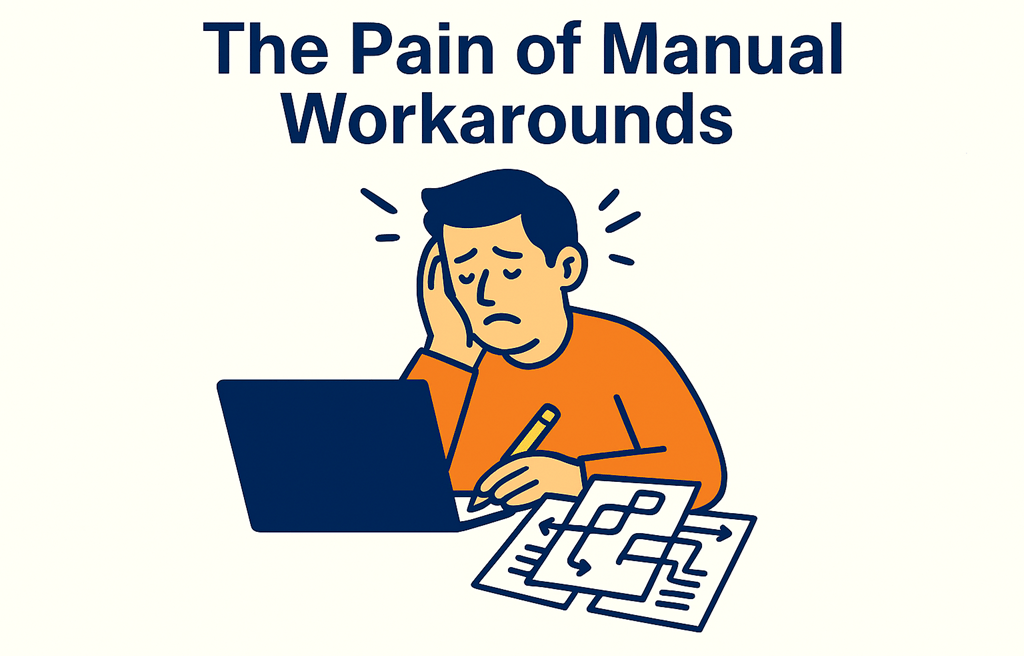

Every business has them.
The spreadsheet that “just helps for now.”
The email approval step added because the system can’t handle it.
The manual check someone always does before sending things out.
These workarounds keep things moving — but they come at a cost.
And when it comes to automation, they’re one of the biggest blockers.
Why workarounds appear in the first place
Workarounds usually start with good intentions.
A process breaks.
Data isn’t quite right.
A system can’t handle an exception.
So someone patches it manually.
Over time, those patches become the process.
The hidden problems workarounds create
Manual fixes slowly introduce:
• delays
• inconsistency
• dependency on individuals
• higher error rates
• lack of visibility
They feel small — but at scale, they add up fast.
Why automation struggles in workaround-heavy environments
Automation works best with clear, standard flows.
Workarounds mean:
every case is slightly different
exceptions are everywhere
rules are unclear
data changes manually
When you automate this, you don’t remove the complexity.
You hard-code it.
And suddenly your automation is fragile and expensive to maintain.
Workarounds are a symptom, not the solution
They usually signal:
• unclear processes
• poor data quality
• missing controls
• lack of ownership
Until those are fixed, automation won’t deliver its promise.
What automation-ready businesses do instead
They focus on:
✔ simplifying processes
✔ removing unnecessary exceptions
✔ fixing data issues at the source
✔ putting simple checks in place
Once the flow is clean, automation becomes straightforward.
A quick workaround test
Ask your team:
“What manual steps do you always have to do to make this process work?”
If the list is long, automation will struggle.
The good news
Most workarounds can be removed with:
• clearer processes
• better data
• simple governance
No massive systems required.
Just clarity.
Want to see where workarounds are blocking your automation?
Our free 15-minute Automation Readiness Assessment highlights:
• process friction points
• data gaps
• governance weaknesses
• quick wins to fix first
👉 Take the readiness check and get your clarity score.